
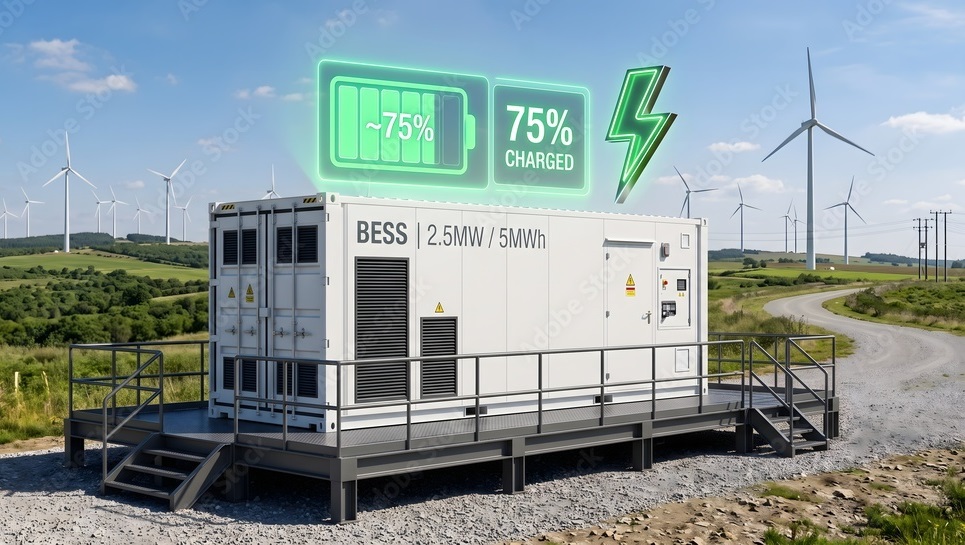

When we talk about Battery Energy Storage Systems (BESS), the conversation usually focuses on batteries, energy density, thermal management, fire safety, grid integration and system performance.
But behind all of these technologies is a physical structure that has to bring the complete system together.
The BESS container or enclosure.
At first glance, a BESS container may appear to be a large fabricated box.
From a manufacturing perspective, it is anything but simple.
A modern BESS enclosure can involve large sheet-metal panels, structural reinforcements, doors and access panels, HVAC openings, cable entries, electrical mounting provisions, fire-system interfaces, sealing arrangements, coating and final assembly.
At Lasercut Steelworks Pvt. Ltd. (LSW), we have already manufactured a BESS enclosure, and the experience highlighted something important:
As BESS technology advances, the enclosure is becoming a manufacturing challenge in its own right—not simply a housing for an energy-storage system.
1. Why Is a BESS Container Becoming a Manufacturing Problem?
The answer is simple:
More systems have to fit into the same physical structure.
A BESS enclosure may need to accommodate:
- Battery modules and associated equipment
- Electrical panels and equipment
- HVAC or cooling systems
- Fans and ventilation arrangements
- Cable-entry systems
- Fire-detection and suppression provisions
- Internal mounting structures
- Doors and access panels
- Service access areas
- Structural reinforcement
- Lifting and handling provisions
- Gaskets and sealing arrangements
- Protective surface coatings
Each requirement creates another manufacturing interface.
The challenge is therefore no longer simply:
"Can we fabricate the enclosure?"
It becomes:
"Can we fabricate the complete enclosure while maintaining the dimensional, structural, sealing, finishing and assembly requirements of the system?"
This is where BESS and renewable-energy fabrication starts to look very different from conventional sheet-metal fabrication.
2. The Real Challenge Starts When the Drawing Reaches the Shop Floor
A BESS enclosure can look perfectly straightforward on a CAD drawing.
The manufacturing floor tells a different story.
Can the large panels be cut accurately?
Can the required bends be produced consistently?
Will the bending sequence create interference?
Can the welding sequence control distortion?
Will doors and removable panels align correctly?
Will HVAC openings match the equipment?
Will cable-entry provisions be positioned correctly?
Will everything still fit after coating?
These are not purely design questions.
They are manufacturing questions.
This is why design-for-manufacturing becomes increasingly important in BESS projects.
LSW's CAD Design & Prototyping capability forms part of this approach, helping translate sheet-metal designs into manufacturable components before production.
3. Large Enclosures Magnify Small Errors
One of the biggest manufacturing challenges with large enclosures is that relatively small dimensional variations can become significant during final assembly.
Consider a mounting plate.
If one hole is slightly out of position, it may not look like a major problem.
But when that mounting plate has to interface with equipment supplied by another manufacturer, the difference can suddenly become critical.
The same applies to:
- Door alignment
- Mounting-hole positions
- HVAC openings
- Cable entries
- Internal brackets
- Access panels
- Structural members
- Electrical equipment mounting plates
A few millimetres of variation can result in:
- Installation difficulty
- Component interference
- Additional fitting work
- Rework
- Assembly delays
This is why dimensional control has to exist throughout the manufacturing process—not only during final inspection.
4. Laser Cutting Is Only the Beginning
A typical BESS enclosure manufacturing process can involve:
Customer Drawing → Manufacturing Review → Laser Cutting → CNC Bending → Welding → Grinding & Deburring → Coating → Assembly → Inspection
Every stage influences the next.
Laser cutting establishes the geometry.
Bending establishes the relationship between surfaces.
Welding can introduce heat and dimensional movement.
Grinding and finishing affect interfaces.
Coating adds another process that needs to be considered.
Assembly ultimately tests whether everything produced in the previous stages fits together as intended.
This is why manufacturing capability cannot be evaluated by looking at a single machine.
The real capability is the ability to control the complete manufacturing chain.
LSW's CNC laser cutting capability supports precision fabrication of components for renewable-energy applications, including battery-storage enclosures.
5. Welding Is Not Just About Strength
Large BESS enclosures can contain numerous welded components, reinforcements, brackets and structural elements.
But welding has two jobs.
The first is obvious:
Create a strong and reliable joint.
The second is equally important for large fabricated assemblies:
Maintain the required geometry.
Heat input and welding sequence can influence:
- Panel flatness
- Squareness
- Door alignment
- Mounting-hole positions
- Overall dimensions
- Assembly fitment
A component can be dimensionally correct before welding and still require correction after welding.
This makes welding sequence, accessibility and process control important considerations during BESS enclosure fabrication.
LSW's broader fabrication and welding techniques are part of an integrated manufacturing process covering cutting, bending, welding, fabrication, finishing and assembly.
6. HVAC and Ventilation Turn the Enclosure Into an Interface
Battery systems generate heat during charging, discharging and operation.
Depending on the BESS architecture, thermal management may involve HVAC systems, fans, ventilation, heat exchangers or other cooling arrangements.
For the enclosure manufacturer, this means accurately producing the physical interfaces required by the thermal-management system.
These can include:
- HVAC cut-outs
- Fan openings
- Louvers
- Ventilation openings
- Airflow openings
- Mounting provisions
- Service openings
- Cable and piping penetrations
The enclosure manufacturer may not be designing the cooling system.
But the manufacturer still needs to produce the openings, mounting points and interfaces accurately enough for that system to be installed.
This is where fabrication accuracy becomes part of system integration.
7. Fire Safety Adds Another Layer of Manufacturing Complexity
Fire safety is an important consideration in BESS projects.
The enclosure may need to accommodate fire-detection, fire-suppression and fire-sealing systems specified by the BESS system designer.
From a manufacturing perspective, this can involve:
- Mounting provisions
- Openings for fire-system components
- Sealing locations
- Cable-entry arrangements
- Access panels
- Reinforcement around mounting points
- Integration of purchased fire-safety components
This creates an important distinction.
The fabricator may manufacture the enclosure and provide the required provisions, but the fire-performance requirement should be based on the specified system, tested components and applicable project requirements.
In other words:
The enclosure is part of the physical fire-safety architecture, but it should not be treated as the fire-safety system itself.
8. IP Protection Is Also a Manufacturing Issue
IP protection is often discussed as a specification.
But achieving the intended protection level depends heavily on manufacturing and assembly.
Consider the chain:
Door → Gap → Gasket → Compression → Panel → Joint → Cable Entry
Every interface can matter.
Poorly controlled door dimensions can affect gasket compression.
Incorrect openings can affect cable-entry arrangements.
Inconsistent panel fitment can create unwanted gaps.
For this reason, IP-related requirements need to be considered during manufacturing planning and assembly—not simply checked at the end.
LSW manufactures BESS-related enclosures according to customer-provided drawings and specifications, with the required IP rating and sealing arrangement remaining project-specific requirements defined by the customer or system designer.
9. Material Selection Changes the Manufacturing Approach
BESS enclosures can be manufactured using different materials depending on the approved design, environmental conditions, structural requirements, corrosion requirements and weight considerations.
Potential materials include:
- Mild Steel
- GI / Galvanized Steel
- Stainless Steel
- Aluminium
Each material behaves differently during manufacturing.
Cutting, bending, welding, finishing, handling and coating requirements can all change depending on the material and thickness.
This is why material selection and manufacturing capability should not be treated as completely separate decisions.
LSW's sheet-metal fabrication capabilities cover multiple manufacturing processes and materials, allowing projects to be handled according to the customer's approved design and specification.
10. The Manufacturing Problem Is Actually a Coordination Problem
This may be the most important lesson from manufacturing a BESS enclosure.
No single process determines whether the final enclosure will be successful.
Imagine one component going through:
Laser Cutting → Bending → Welding → Grinding → Coating → Assembly
A dimensional issue introduced during one stage can affect every stage that follows.
That means the important question is not:
"Can you laser cut this part?"
or
"Can you weld this enclosure?"
The more important question is:
"Can you manufacture, finish, assemble and inspect the complete enclosure while maintaining the required interfaces?"
That is a much more demanding manufacturing requirement.
11. Why Integrated Manufacturing Matters
For BESS OEMs, EPCs and system integrators, using separate vendors for cutting, bending, welding, coating and assembly creates additional coordination points.
Every handover creates another interface.
An integrated manufacturing partner can simplify this chain.
At LSW, the manufacturing workflow can cover:
Laser Cutting → CNC Bending → Welding / Laser Welding → Grinding & Deburring → Coating → Assembly → Inspection
This approach allows multiple manufacturing stages to be coordinated within one production setup.
Our Assembly & Integration services specifically include battery storage enclosures and inverter housings for renewable-energy applications.
The objective is straightforward:
One approved design → One coordinated manufacturing process → One finished assembly.
12. What Manufacturing a BESS Enclosure Taught Us
Manufacturing a BESS enclosure gives you a perspective that is difficult to get from a drawing alone.
The challenge is not one particular operation.
It is the interaction between all of them.
Laser cutting affects bending.
Bending affects assembly.
Welding affects dimensional stability.
Dimensional stability affects doors, panels and mounting interfaces.
Finishing affects the final interfaces.
And assembly ultimately tells you whether the complete manufacturing chain has worked as intended.
That is why we see BESS enclosure manufacturing as a system of manufacturing processes, rather than simply another sheet-metal fabrication job.
The enclosure has to successfully move through every stage before it becomes a usable BESS assembly.
13. Surface Protection Is Part of the Product
BESS installations can be exposed to demanding environments, particularly where outdoor installation is involved.
That makes surface protection an important part of the finished enclosure.
Depending on the customer's specification, finishing may involve painting, powder coating or other specified protective systems.
LSW's powder coating services provide protective finishing for sheet-metal fabrication, including options designed for durability and resistance to environmental exposure.
But coating is not simply a cosmetic final step.
It has to be considered alongside:
- Surface preparation
- Assembly interfaces
- Masking requirements
- Mounting surfaces
- Gasket interfaces
- Required finish
- Corrosion protection
The final enclosure is the result of all these processes working together.
14. The BESS Industry Will Need Manufacturing Partners, Not Just Fabricators
As BESS projects become larger and more sophisticated, the physical enclosure will also become more demanding.
More equipment.
More interfaces.
More thermal-management requirements.
More electrical connections.
More safety provisions.
More dimensional requirements.
And potentially higher production volumes.
This means the BESS industry will need not only better battery technology and energy-management systems, but also manufacturing partners capable of consistently converting complex engineering designs into physical products.
The manufacturing challenge is therefore becoming an important part of the energy-storage challenge.
Conclusion: BESS Is an Energy Problem—and Increasingly a Manufacturing Problem
The success of a BESS project depends on the complete system working together.
The battery technology may be advanced.
The control system may be sophisticated.
The thermal-management system may be carefully engineered.
But all of these systems still need a physical enclosure that can accommodate them accurately and consistently.
That is why we believe:
BESS containers are no longer just an energy-storage enclosure. They are becoming a manufacturing product with their own engineering, fabrication, quality and assembly challenges.
At Lasercut Steelworks Pvt. Ltd. (LSW), we are building our capabilities around this requirement—from laser cutting and CNC bending to welding, powder coating and assembly & integration.
We have already manufactured a BESS enclosure, and that experience reinforces a simple principle:
A good BESS design becomes valuable only when it can be manufactured accurately and consistently.
If you have a BESS enclosure, battery cabinet or energy-storage equipment housing that needs to move from drawing to production, talk to LSW about your next project.


0 Comments