

Lasercut Steelworks Pvt. Ltd. (LSW) | BESS Manufacturing Series
Understanding the stages of thermal runaway, gas generation, fire propagation and the critical role of enclosure manufacturing in Battery Energy Storage Systems.
A BESS fire does not normally begin with an explosion.
In many incidents involving Battery Energy Storage Systems (BESS), the visible fire or pressure event represents a later stage of a process that may have started inside a single battery cell. Heat generation, internal chemical reactions, gas release and the potential involvement of neighboring cells can develop before an incident becomes visible from outside the container.
This sequence makes thermal runaway one of the most important safety considerations in battery energy storage.
As energy storage installations become larger, the physical enclosure must accommodate an increasingly complex combination of battery racks, electrical equipment, cooling systems, monitoring devices, ventilation arrangements and fire-safety provisions. These components must work together as part of a properly engineered system.
For developers, EPC contractors, battery manufacturers and enclosure fabricators, understanding the sequence of events is essential. It helps clarify why BESS safety is not simply a question of selecting stronger steel or building a weather-resistant container.
At Lasercut Steelworks Pvt. Ltd. (LSW), our focus is on precision sheet-metal fabrication and the accurate manufacturing of enclosures and their specified interfaces. Understanding the safety requirements of BESS applications helps us appreciate why dimensional accuracy, opening locations, mounting provisions and manufacturing quality matter.
1. What Is Thermal Runaway?
Thermal runaway is an uncontrolled self-heating process in which heat-generating reactions inside a battery cell accelerate and can exceed the cell's ability to dissipate heat.
Under certain failure conditions, a cell's internal temperature begins to rise. As the temperature increases, additional chemical reactions may occur, generating more heat. This can create a self-accelerating process that becomes difficult to stop once it is established.
Depending on the battery chemistry, cell construction and failure conditions, the process can involve internal damage, gas generation, pressure buildup, venting and potentially ignition.
A simplified sequence is:
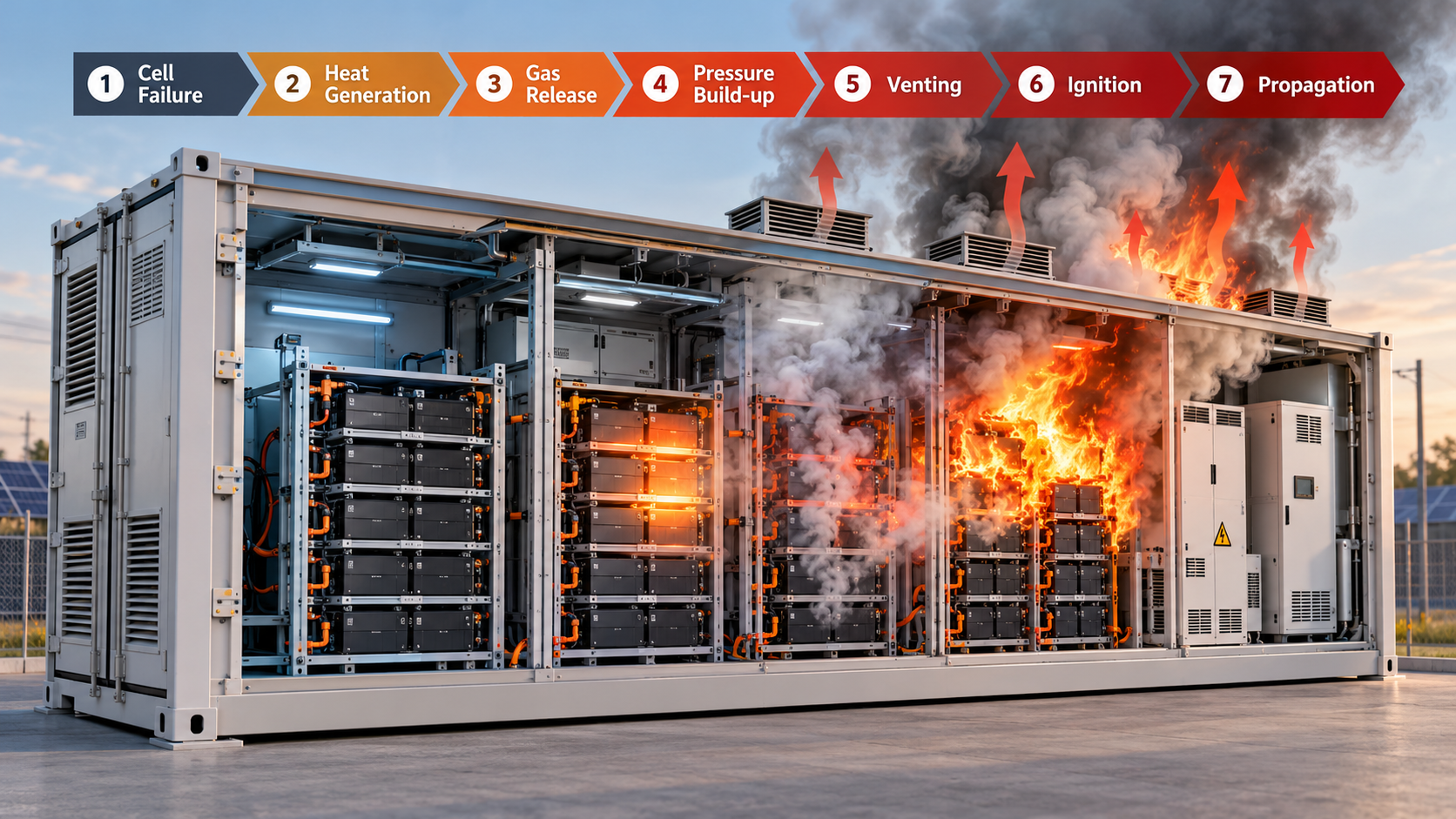
Cell failure → Heat generation → Temperature rise → Gas generation → Pressure increase → Venting → Potential ignition → Possible propagation
This sequence is illustrative rather than universal. Not every incident follows precisely the same stages, and the timing and severity can vary considerably.
The important point is that thermal runaway is not a single moment. It is a developing hazard that may create several different risks for the battery system and its surroundings.
These risks can include:
- High temperatures and the release of hot gases.
- Flammable gas accumulation under certain conditions.
- Fire and thermal exposure to neighbouring cells or equipment.
- Pressure hazards if combustible gases accumulate and ignite.
- Challenges for emergency response and post-incident management.
For a broader understanding of the physical structures used in these applications, LSW's Renewable Energy sector provides relevant context for its work in energy-related enclosure applications.
2. Why Can a BESS Incident Begin Inside a Single Cell?
A typical BESS contains many individual battery cells assembled into modules, racks and larger system configurations. The precise arrangement depends on the battery technology and the manufacturer's design.
This layered structure is important because an abnormal event may begin at a very small scale while potentially affecting a much larger installation.
A cell may experience an internal short circuit, mechanical damage, manufacturing-related defects, electrical abuse or exposure to unsuitable operating conditions. These are examples of possible initiating factors, not an exhaustive list of causes.
If the resulting heat cannot be controlled, the cell may enter thermal runaway.
The next challenge is preventing the event from affecting neighbouring cells and equipment.
Heat can transfer through direct contact, structural components, hot gases and other pathways. If neighbouring cells reach conditions that trigger their own failures, the incident may propagate beyond the original cell.
This is why BESS safety requires more than placing batteries inside a steel enclosure.
Depending on the system, the safety strategy may include battery-management systems, temperature monitoring, electrical protection, thermal management, fire detection, suppression, gas detection, ventilation, pressure-relief provisions and separation between equipment.
Each measure has a specific function. No single measure should be assumed to prevent every possible failure.
3. What Happens Inside the Container Before a Fire?
The exact progression varies by battery chemistry, system architecture and failure scenario. However, the following stages help explain how an initially localised battery problem can develop into a more serious event.
Stage 1 — Cell abnormality or failure
The process may begin with an internal cell defect, electrical fault, mechanical damage or another abnormal condition.
Initially, there may be no visible fire outside the battery system. The condition may be detectable only through appropriate monitoring, inspection or testing, depending on the failure mode.
Stage 2 — Heat begins to accumulate
The affected cell starts generating heat faster than it can release it.
The cell's temperature rises, potentially affecting its internal materials and components. If heat transfer to surrounding cells is not adequately controlled, neighbouring cells may also experience increased temperatures.
Stage 3 — Internal reactions accelerate
As the temperature rises, certain internal chemical reactions can accelerate. Depending on the cell design and chemistry, these reactions may generate additional heat and contribute to a loss of cell integrity.
Once the process becomes self-sustaining, simply removing the original electrical load may not be enough to stop it.
Stage 4 — Gas generation and pressure increase
Battery failure can produce gases and vapours. The quantity and composition depend on the battery chemistry, cell design and failure conditions.
Gas generation can increase internal pressure within the cell. If the pressure exceeds the cell's design limits, the cell may vent through its designated or failure-related release path.
At this point, the event may introduce additional hazards around the battery rack and within the surrounding enclosure.
Stage 5 — Hot gases and vapours are released
Venting can release hot gases and vapours into the surrounding space.
Depending on their composition, concentration and the environmental conditions, these releases may create toxicity, flammability, heat and pressure hazards.
The presence of gas does not automatically mean an explosion will occur. The outcome depends on factors such as gas composition, concentration, oxygen availability, ventilation, confinement and the presence of an ignition source.
Stage 6 — Potential ignition and fire
If combustible gases encounter suitable ignition conditions, combustion may occur. A fire can also develop directly from the battery failure and associated materials.
The nature and severity of the event depend on the system and the failure scenario.
This is why detection, gas management, ventilation and fire-protection measures must be considered together in the approved system design.
Stage 7 — Potential propagation
If heat transfer to neighboring cells is not sufficiently controlled, further cells may become involved.
As more cells participate, the amount of heat and gas released can increase. The event may then challenge equipment, structural components and safety measures beyond the original point of failure.
The key lesson: a problem that begins inside one cell can develop into a system-level incident. Preventing escalation requires coordinated design, appropriate protection measures and correctly manufactured physical interfaces.
4. Why Does an Explosion Sometimes Occur?
Thermal runaway, fire and explosion are related hazards, but they are not interchangeable terms.
Thermal runaway describes an uncontrolled self-heating process inside a battery cell. Fire involves combustion. An explosion or pressure event can occur under certain conditions when combustible gases accumulate and ignite rapidly, creating a pressure rise.
A possible scenario is:
- A battery failure generates flammable gases.
- The gases are released into the surrounding space.
- Under some conditions, the gases accumulate within an enclosure or other confined area.
- The gas mixture reaches an ignitable concentration and encounters an ignition source.
- Rapid combustion produces a pressure event.
This is a simplified scenario, not a prediction that every thermal-runaway incident will result in an explosion.
Gas behaviour depends on its composition, release rate, temperature, concentration and movement through the enclosure. The available ventilation, confinement and ignition conditions also influence the outcome.
For this reason, explosion-risk management must be addressed by competent system designers using the applicable project requirements and risk assessments.
Depending on the installation, the approved design may specify gas detection, ventilation, deflagration protection, pressure-relief arrangements or other protective measures. These provisions must be selected and engineered for the actual hazard; they cannot be replaced by a generic enclosure feature.
The fabricator's responsibility is to manufacture the specified arrangement accurately. Any changes to openings, panels, seals or pressure-relief interfaces should be reviewed and approved by the responsible design authority.
5. Why Does the BESS Enclosure Matter?
A BESS enclosure is not merely a weatherproof box around batteries. It provides the physical structure that supports and protects the equipment while accommodating the interfaces required by the approved design.
Although the enclosure cannot prevent every battery failure, its construction can affect whether the specified safety and operational features are installed correctly and remain usable.
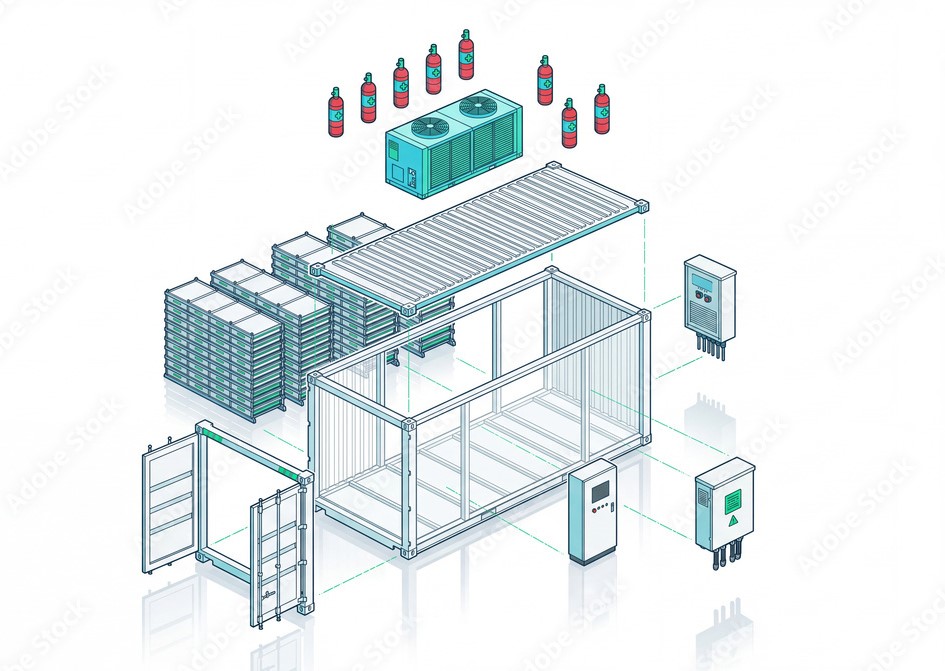
Depending on the project, the enclosure may need to accommodate:
- Battery racks and supporting structures.
- HVAC equipment and associated openings.
- Electrical cabinets and cable-entry points.
- Fire-detection and suppression equipment.
- Gas detection and ventilation provisions.
- Internal partitions and equipment separation.
- Access doors, service panels and maintenance clearances.
- Sealing arrangements and environmental protection.
- Designated pressure-relief or other safety interfaces.
The exact arrangement must be established by the system designer and relevant project requirements.
For the fabricator, the challenge is to translate the approved drawings and specifications into a physical enclosure without introducing unintended deviations.
An opening in the wrong location can interfere with equipment installation. A poorly positioned mounting plate can affect alignment. An incorrectly manufactured door or panel can compromise fit-up or interfere with specified sealing arrangements.
These are manufacturing issues, but their consequences can extend into assembly, inspection, maintenance and system integration.
At LSW, sheet-metal fabrication supports the production of fabricated metal components according to project requirements. The objective is to manufacture the specified structure and interfaces accurately—not to substitute fabrication decisions for engineering decisions that belong to the system designer.
6. Fire Safety Is Not Simply a Question of Steel Thickness
One of the common misconceptions about industrial enclosures is that a thicker steel wall automatically makes the system safer.
Material thickness can influence structural performance and certain forms of thermal exposure, but it does not, by itself, resolve the full range of BESS hazards.
For example, a thicker panel does not automatically prevent:
- Thermal runaway inside a battery cell.
- Heat transfer between neighbouring cells.
- The accumulation of flammable gases.
- Ignition or rapid combustion.
- Inadequate ventilation or unsuitable gas-management arrangements.
- Incorrectly located safety equipment or openings.
The enclosure's required material, thickness, reinforcement and construction details must therefore follow the approved design and applicable performance requirements.
A stronger structure may be appropriate for a particular application, but the selection must be based on engineering analysis rather than a general assumption that more steel always means more safety.
Equally important, the enclosure should not be modified casually after the design has been approved. Additional openings, altered seals, changed partitions or relocated components may affect the intended performance of the overall system.
The correct approach is to coordinate structural design, thermal management, fire protection, gas management and fabrication requirements from the beginning.
7. Why Manufacturing Accuracy Matters in BESS Enclosures
A BESS enclosure can contain many interconnected components, each with its own dimensional and installation requirements.
The enclosure may need openings for cooling equipment, mounting points for electrical cabinets, cable-entry arrangements, access doors and designated interfaces for safety systems. These features must align with the approved layout.
Manufacturing accuracy becomes particularly important in the following areas.
Panel dimensions and fit-up
Panels that do not meet the specified dimensions can create assembly difficulties, alignment problems and avoidable rework.
Openings and equipment interfaces
HVAC openings, cable entries and equipment cut-outs must be located and manufactured according to approved drawings. Unauthorised changes can affect equipment fitment and system interfaces.
Welding and structural assembly
Frames, reinforcements and mounting structures must be fabricated according to the specified geometry and welding requirements. The applicable inspection and acceptance criteria should be defined by the project documentation.
Doors, access and sealing
Doors and access panels must fit as intended, while specified sealing arrangements must be installed correctly. This supports the enclosure's intended environmental protection and serviceability.
Finish and corrosion protection
The specified coating or finishing system must be appropriate for the intended operating environment. Surface preparation, application and inspection should follow the approved requirements.
LSW's manufacturing capabilities include laser cutting, press-brake and metal-folding services and welding services. These processes can support the production of accurate enclosure components when executed against the approved specifications and drawings.
The value lies not simply in having individual manufacturing processes available, but in coordinating them to achieve the required finished geometry and assembly interfaces.
8. Why Early Design Coordination Reduces Risk
Many enclosure-related challenges are easier to address before production begins than after fabrication or installation.
A design that looks complete on a drawing may still require coordination between the battery layout, cooling equipment, cable routing, structural members, access requirements and safety-system interfaces.
If these requirements are not aligned early, issues may be discovered only during assembly or site installation.
For example, a mounting bracket may obstruct a cable route. A structural member may interfere with an equipment opening. A service panel may not provide the required access to a component. A specified ventilation arrangement may conflict with another part of the layout.
These examples do not necessarily indicate a failure of the safety concept. They illustrate why design coordination and manufacturing review are important before the enclosure enters production.
Digital design review, dimensional checks and manufacturing planning can help identify avoidable conflicts.
LSW's CAD designing and prototyping services provide a relevant starting point for discussing how enclosure geometry and component interfaces can be prepared for manufacturing.
Where the project calls for it, the responsible parties should review drawings, interface dimensions, access requirements, opening locations and revision control before releasing components for production.
Any proposed change affecting a safety-related feature must be referred to the authorised design team for approval.
9. Finishing, Assembly and Environmental Protection
BESS installations may operate in demanding environments where enclosure components are exposed to moisture, dust, temperature variation and other site-specific conditions.
The required level of protection depends on the project specification and installation environment.
Finishing is therefore more than an aesthetic consideration. The specified coating system and surface preparation can contribute to corrosion protection and long-term durability.
However, the suitability of a coating depends on the substrate, preparation, application method, operating environment and the performance requirements established for the project.
Similarly, assembly quality affects how components fit together and how specified interfaces are completed.
LSW provides powder-coating services and electro-mechanical assembly services as part of its manufacturing capabilities. The applicable process and scope should always be matched to the customer's approved requirements.
A coating process or assembly activity should not be assumed to establish a fire rating, explosion rating or other safety certification unless the relevant performance has been specifically evaluated and documented.
10. Why Testing and Validation Matter
Small-scale battery tests can provide valuable information about cell behaviour, but they cannot necessarily predict every outcome in a large installation.
When multiple modules, racks, electrical systems and enclosure components interact, the physical conditions may differ from those observed in an individual-cell test.
Depending on the design and intended application, validation may need to consider thermal behaviour, propagation, gas release, ventilation, fire protection and pressure-related hazards.
Large-scale testing can be important where the relevant hazard assessment or project requirements call for it. The applicable test methods and acceptance criteria depend on the system, jurisdiction and intended use.
It is equally important to distinguish between different types of evidence:
- Component inspection verifies that manufactured parts meet specified dimensions and workmanship requirements.
- Assembly inspection checks the fit and installation of components and interfaces.
- System testing evaluates defined system functions or performance.
- Fire and explosion-related testing addresses particular hazards under specified test conditions.
These activities are not interchangeable. A dimensionally accurate enclosure does not, by itself, demonstrate that a complete BESS has passed fire or explosion testing.
Likewise, successful testing of a particular configuration should not automatically be assumed to cover a materially different design.
The required evidence must be established by the responsible design authority, testing organisation and project specification. The fabricator's role is to provide products and manufacturing records within its agreed scope.
11. What Should Developers and EPC Contractors Discuss With an Enclosure Manufacturer?
Early discussions between developers, EPC contractors, battery-system suppliers and fabricators can reduce uncertainty before production begins.
When evaluating an enclosure manufacturing partner, consider the following questions:
1. Are the drawings and specifications approved for production?
The production team should have access to the correct drawing revisions, material specifications, dimensions and acceptance criteria.
2. Are all equipment interfaces defined?
Battery racks, HVAC equipment, electrical cabinets, cable entries, doors and specified safety-system provisions should be coordinated before fabrication.
3. Are manufacturing processes aligned with the requirements?
Laser cutting, bending, welding, finishing and assembly should follow the approved design and applicable quality requirements.
4. How are dimensional accuracy and workmanship verified?
Inspection methods and acceptance criteria should be established before manufacturing begins.
5. How are drawing changes controlled?
Changes to openings, mounting locations, panels or other interfaces should be documented and approved by the relevant authority.
6. What documentation will be supplied?
The required inspection records, material documentation, coating records and other deliverables should be agreed at the start of the project.
7. Which safety responsibilities remain with the system designer?
Fire strategy, gas management, ventilation, suppression, pressure relief and overall system performance must be assigned to competent parties and addressed in the approved design.
These questions help establish a clear boundary between enclosure manufacturing and system engineering. They also help ensure that the enclosure is treated as an important part of the complete BESS installation rather than as an isolated fabricated product.
Conclusion: A Safer BESS Begins With Understanding the Entire System
Thermal runaway is not simply an explosion that suddenly occurs inside a battery container. It is a potentially escalating process that may begin with a single cell and develop through heat generation, gas release, venting, fire and possible propagation.
An explosion or pressure event is a separate potential hazard that depends on the conditions under which gases accumulate and ignite.
Managing these risks requires a coordinated approach involving battery design, monitoring, thermal management, fire protection, gas management, ventilation, pressure-related protection where required, and the physical design of the installation.
The enclosure is one component of that larger system—but it is an important one.
Its panels, frames, openings, mounting points, doors and interfaces must be manufactured in accordance with the approved design. Manufacturing deviations can create avoidable integration problems, while accurate fabrication helps the specified equipment and safety provisions fit as intended.
At Lasercut Steelworks Pvt. Ltd. (LSW), our role is to support industrial enclosure applications through precision sheet-metal manufacturing and the accurate execution of approved drawings and specifications.
The safest enclosure is not simply the strongest enclosure. It is the enclosure manufactured correctly as part of a properly engineered and validated BESS system.
Explore LSW's renewable energy capabilities and sheet-metal fabrication services to learn more about our manufacturing approach.



0 Comments